
The UV spectroscopy technology can be considered the most reliable and stable method, used to analyse the specific parameters: Ammonia, Chemical Oxygen Demand (COD), Hydrocarbons, Nitrate, Chlorophyll A and Color. Designed in compliance with CE electromagnetic standards and using a water tight IP54 enclosure, this online analyser is the ideal instrument for the most challenging industrial applications and environments. In the market, it consists of 3 methods as below:
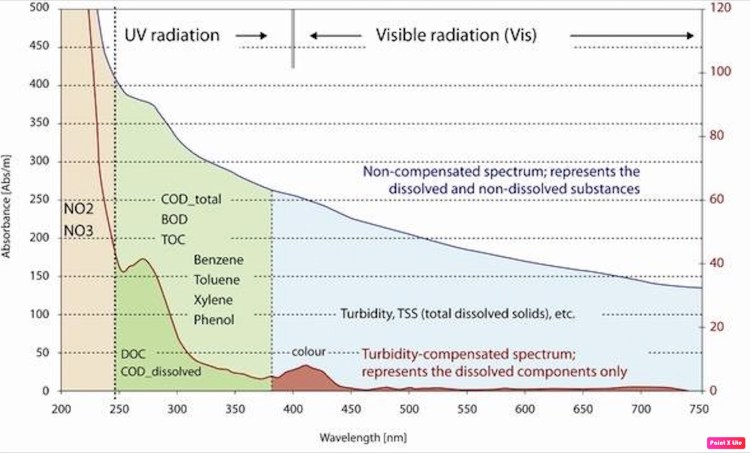
UV Spectroscopy Online Analyser
Designed in compliance with CE electromagnetic standards and using watertight IP54 enclosure, the Analyser is the ideal instrument for industrial application such as:
- Water treatment plants
- Industrial influents & effluents monitoring
- River monitoring
- Aquaculture & Agriculture
- Chemical, oil and food industries
Benefits
- UV lamp that can last 10 years lifetime
- Better reliable sampling pump that is able to reach a pump height of up to 5 meters
- No toxic chemical needed for reaction
- Quick testing time, in less than a minute
- Good repeatability by automation measurement
- Auto cleaning features that can be programmable
- Various testing modes available: Continuous/Interval/Test on demand triggered by external signal
- Ad-hoc measurement features, for verification or sample testing.
- Manual datalogging with RS232 download (Standard)
- Connectivity to PLC or wireless network by means of 4-20mA output or RS485 (optional)
- Monitoring of multiple streams (up to 4) possible by multiplexing configuration (built-in feature)
- Easy maintenance
- Possible optional add-on for pH and TDS/EC
Absorption Measurement Principle
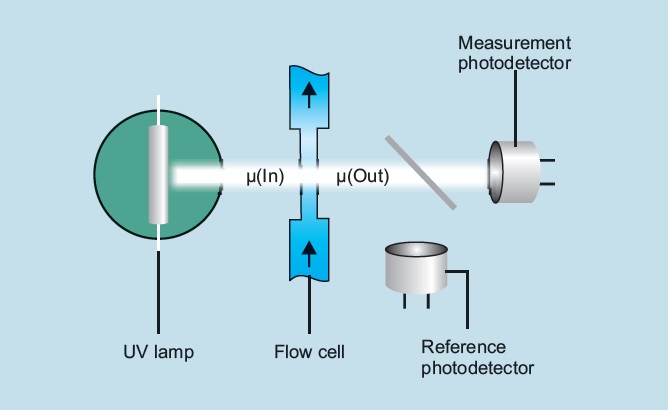
The measuring principle is based on the UV VIS Absorption method.
[C] = k log (lin/lout)
With:
[C]: concentration of the sample
K: absorption coefficient (specific to each molecule)
lin: light intensity at the input of the sample
lout: light intensity at the output of the sample
UV Fluorescene Measurement Principle
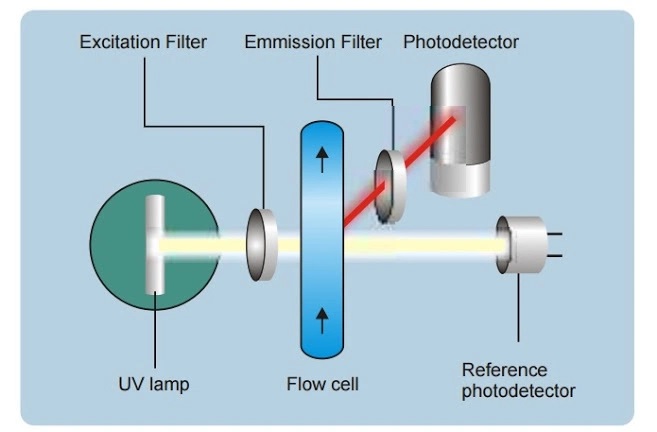
The measuring principle is based on the fluorescence when light at a specific wavelength (excitation), some chemicals remit light (emission) at another longer wavelength.
The emission (emitted light) is detected by a high precision photomultiplier sensitive enough to detect very low concentrations down to a few ppb. The excitation light is controlled by a detector to compensate for any variance of the source.
UV Spectroscopy (FFT) Measurement Principle
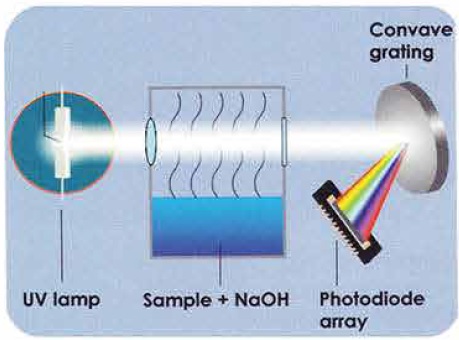
The measuring principle is based on the UV light absorption spectrum of Ammonia gas NH3 in equilibrium with dissolved ammoniac gas in water sample
A small quantity of Sodium Hydroxide (NaOH) is added to the sample to increase the pH to convert NH4+ to NH3.
A Fast Fourier Transform (FFT) is applied on the spectrum to extract the absorption signal typical to ammoniac gas. This method is very selective and no interference is known on river or wastewater.
Moreover, turbidity or color of the water has no influence as the measurement is performed in the gaseous phase.
Wastewater with suspended solids, such as activated sludge can be sampled without filtering.
This method is known since 1956 but requires strong mathematical signal processing that only powerful microprocessor-based instruments can handle.
Add-on parameters :
 H2O Engineering & Trading